The Question Everyone Asks Before They Book
How long does railing installation take UK — and why does nobody give a straight answer?
I’ll tell you why.
Because the honest answer is: it depends.
And I know that sounds like a cop-out.
But stick with me for five minutes and I’ll give you actual timelines, broken down by project type, so you can plan properly — not guess.
Because here’s the thing I see constantly.
A homeowner books a fabricator.
They assume the railings go in next Tuesday.
Then they find out the bespoke steelwork takes three weeks to manufacture first.
Project delayed.
Builder on site twiddling his thumbs.
Tradesman has to rearrange two other jobs.
It’s a mess — and it’s almost always caused by not understanding the full timeline from enquiry to completion.
So let’s fix that right now.
The Quick Answer (If You’re in a Rush)
Here’s the short version before we go deeper:
| Project Type | Installation Time on Site |
|---|---|
| Single handrail on a staircase wall | Half a day to 1 day |
| Residential garden or terrace railings | 1–2 days |
| Balcony or external balustrade | 1–2 days |
| Medium replacement/repair job | 2–5 days |
| Large bespoke residential system | 3–5 days |
| Commercial multi-storey installation | 1–3 weeks on site |
But that’s just the time on site.
The total time from the moment you pick up the phone to the moment your railings are finished?
That’s a different number.
And that’s what we’re going to cover properly.
The Timeline Nobody Talks About — From Enquiry to Completion
Most guides tell you how long the installation takes.
What they skip is everything that happens before the installer even arrives.
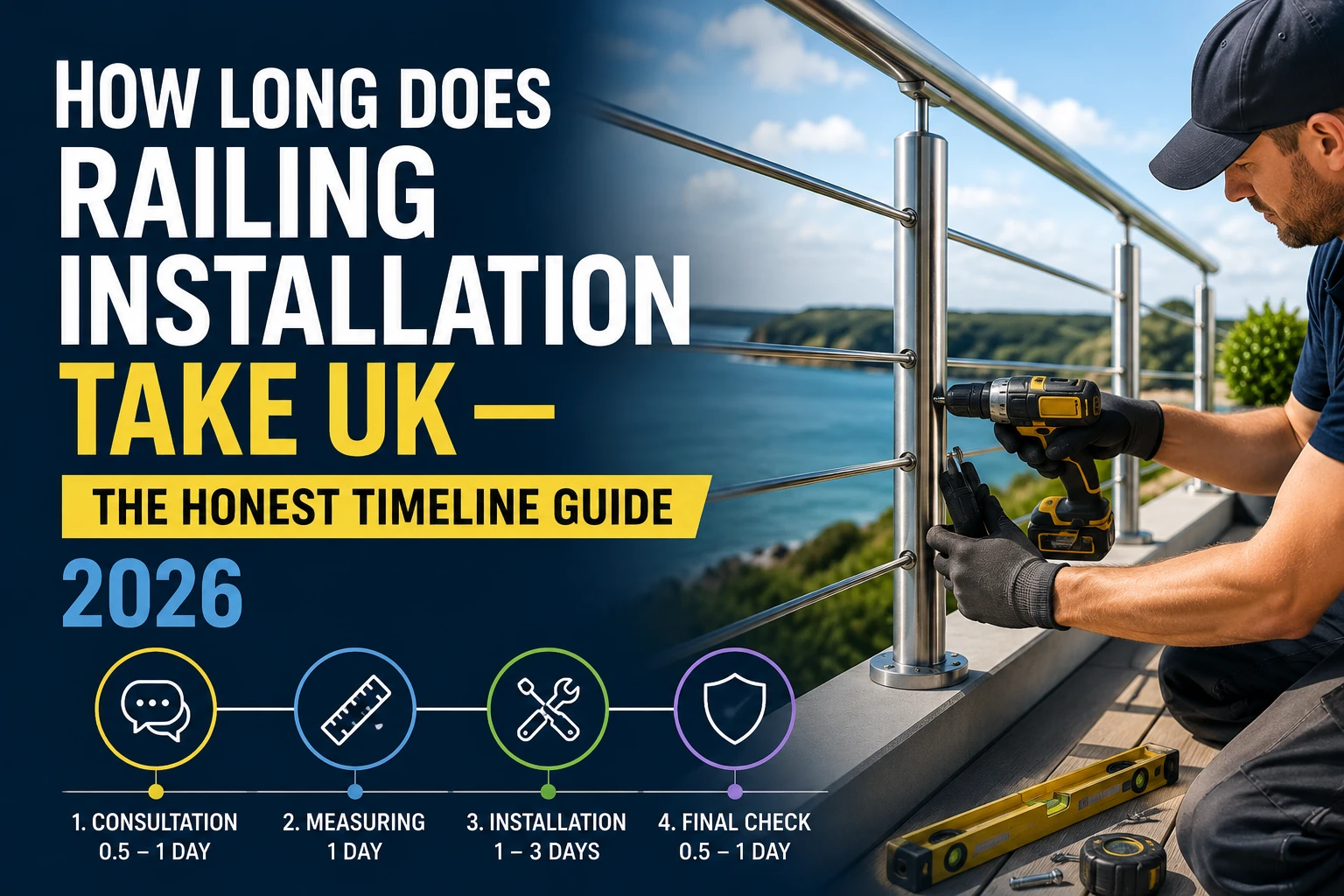
Here’s the full picture for a typical UK railing project:
Stage 1 — Enquiry and Survey (3–10 Days)
You contact a fabricator or installer.
They come out for a site survey — measuring up, checking substrate, confirming the design.
This stage usually takes a few days to a week depending on how busy they are.
In the south east of England, the better fabricators are often booked out further than you’d expect.
Tip: Get your enquiry in early. Don’t wait until the rest of your build is nearly done.
Stage 2 — Design Sign-Off and Quote (3–7 Days)
They draw up a quote and, for bespoke work, produce design drawings.
You review them.
You change your mind about the post spacing.
Or your architect wants to see calculations.
Or you want a different finish.
Every revision adds days.
The fastest projects I’ve seen are ones where the client makes decisions quickly and sticks to them.
Stage 3 — Fabrication Lead Time (2–6 Weeks for Bespoke Work)
Here’s where the big surprise hits most people.
Bespoke railings don’t come off a shelf.
They’re made to order — fabricated in a workshop specifically for your project.
For standard off-the-shelf systems, you skip this stage and move straight to installation.
But for custom metalwork — bespoke steelwork, glass balustrades, ornate ironwork, curved sections — you’re looking at:
- Standard bespoke mild steel railings: 2–4 weeks fabrication
- Stainless steel balustrades: 3–5 weeks fabrication
- Glass balustrade systems: 4–6 weeks from order to delivery
- Complex commercial systems: 6–10 weeks fabrication
This is not the fabricator dragging their feet.
This is the reality of custom metalwork — steel needs to be cut, welded, ground, finished, and quality-checked before it ever reaches your site.
Types of Metal Railings for Residential Properties UK — understand the difference between bespoke and off-the-shelf systems before you commit to a timeline.
Stage 4 — Installation (Half a Day to 3 Weeks)
This is the part you’re most focused on.
And yes — for most domestic projects, the actual installation is the fastest part of the whole process.
More on this in detail below.
Stage 5 — Snagging and Sign-Off (1–2 Days)
For commercial projects or anything involving building control sign-off, factor in a snagging visit.
Minor adjustments, fixing punch-list items, documentation.
For domestic installs it’s usually same-day sign-off.
Installation Time Broken Down by Project Type
Let me give you the real numbers — based on what actually happens on site in the UK.
Single Handrail on a Staircase Wall
On-site time: 2–4 hours
This is the fastest job.
One fabricator, a drill, a level, and a bit of care.
The handrail is usually wall-mounted, pre-made to length, and just needs fixing in place.
Two people can have this done before lunch.
What slows it down:
- Masonry walls that need specialist fixings
- Listed buildings with restrictions on how you drill
- Awkward staircase geometry
Residential Garden Perimeter Railings
On-site time: 1–2 days
A typical garden railing run — say 10 to 20 metres of mild steel with vertical balusters — takes a competent team of two most of a working day.
Longer runs or more complex designs push into a second day.
What slows it down:
- Posts that need concrete foundations (add curing time — typically 24–48 hours before full loading)
- Uneven ground requiring bespoke post heights
- Working around existing landscaping or utilities
External Balcony Balustrade
On-site time: 1–2 days
A standard domestic balcony balustrade — glass or steel — is typically a 1 to 2-day installation.
Two to three fitters for a standard run.
Glass panels take more care and time than steel, especially if the sightlines need to be perfect.
What slows it down:
- Access restrictions (scaffolding already struck? Awkward elevation?)
- Substrate condition (concrete that needs chasing out for post bases)
- Weather — working at height in wind or rain is a safety issue and stops work
Garden or Terrace Balustrade with Glass Infill
On-site time: 2–3 days
Glass systems require more precision.
Each panel needs to sit perfectly.
Any misalignment shows up immediately with glass — there’s nowhere to hide.
A two-person specialist team can typically cover around 8–12 linear metres per day on a clean site.
Medium Repair or Replacement Job
On-site time: 2–5 days
Replacing existing railings — removing the old, prepping the substrate, installing the new — takes longer than a clean-slate install.
Old post bases that need cutting out.
Concrete work.
Repointing brickwork after post removal.
Budget more time than you think for the strip-out element.
Large Bespoke Residential System
On-site time: 3–5 days
Think full-perimeter garden railings, feature staircases, or multi-section balustrades across a large property.
A three-person experienced team, a clean site, and good access can cover a lot of ground.
But complexity adds time — curved sections, ornate details, multiple material types.
Commercial Installation — Multi-Storey or Large Footprint
On-site time: 1–3 weeks on site
Commercial jobs are a different animal.
Multi-storey staircases.
Public-facing balustrades that need to meet higher load ratings.
Coordination with other trades on site.
Building control inspections at certain stages.
These projects don’t finish in a couple of days.
Plan for phased installation across weeks, not days.
Commercial Metal Railings South East England — what to expect when procuring railings for a commercial development.
What Actually Slows Railing Installations Down in the UK
I’ve watched dozens of projects run long.
Here are the real reasons — not the ones installers put in a polite email.
1. The substrate isn’t ready
If your concrete bases haven’t been prepared, your brickwork isn’t in, or your balcony slab isn’t finished — the installer can’t start.
Sounds obvious.
Happens all the time.
2. Weather
The UK is the UK.
Working at height in wind and rain isn’t just unpleasant — it’s a safety risk.
Winter installs on exposed sites can lose days to weather.
Build this into your programme if you’re planning an autumn or winter installation.
3. Last-minute design changes
You decide mid-fabrication that you want horizontal rails instead of vertical.
Or a different post cap.
Or your partner wants the finish changed from satin to mirror polish.
Every change at fabrication stage restarts part of the process.
Lock in your design before the fabricator starts.
4. Access problems
Tight roads, no parking, restricted site access.
A delivery lorry that can’t get close to the property.
Scaffolding that needs erecting before upper-level work can start.
These are things to solve before the installer arrives — not on the day.
5. Waiting on building control or permits
For commercial projects, certain stages may require inspection before you can proceed.
If building control isn’t booked in advance, you can wait days for an available slot.
6. Multiple trades on site
If your installer is the last trade in and the builders are still there, things get messy.
Conflicts over access, sequencing, work areas.
Railings ideally go in towards the end of the build — but with the fabrication ordered early enough that the lead time doesn’t hold everything up.
The South East England Reality Check
I’ll be straight with you about our corner of the country.
The south east — Kent, Surrey, Sussex, parts of Hampshire — has some of the busiest and most in-demand fabricators and installation teams in the country.
London’s commuter belt means constant residential development.
Coastal properties mean constant renovation and upgrade work.
Demand is high. Good teams are booked out.
Here’s what that means practically:
- Lead times from top fabricators are often 4–8 weeks for bespoke work, not the 2–3 weeks you might hope for
- Labour costs run 10–25% higher than the national average — as do scheduling pressures
- Don’t assume you can get anyone good next week — if your project has a firm deadline, book as early as possible
I’ve seen projects stall because a homeowner assumed a 2-week turnaround and their fabricator of choice couldn’t start for six weeks.
Book early.
Confirm lead times in writing.
Get a programme from your installer that shows every stage.
Do I Need Planning Permission for Railings South East England — before you book your fabricator, make sure you’ve checked your planning position.
How to Cut Your Railing Installation Timeline Without Cutting Quality
You can speed things up without compromising the result.
Here’s how:
Make all design decisions before the survey visit
Know what material you want.
Know your preferred finish.
Have reference photos ready.
The more decided you are before the surveyor comes, the faster the quote and sign-off process.
Consider off-the-shelf systems for simpler runs
For straightforward garden perimeter railings or simple balcony balustrades, off-the-shelf modular systems can be installed far faster than bespoke fabrications.
No fabrication lead time.
Order, deliver, install.
For a project where aesthetics don’t demand a custom design, this is a legitimate time-saver.
Prepare your site before the installer arrives
Post bases dug.
Access confirmed.
Other trades cleared from the work area.
An installer who arrives to a ready site can start immediately.
Book your installer and fabricator at the same time you sign off the design
Don’t wait for the design to be perfect before you reserve a slot.
You can adjust minor details later.
But if you wait for a perfect set of drawings before calling the installer, you’ve lost weeks in the diary.
Give clear, written briefs
Don’t rely on conversations and assumptions.
Written confirmation of material, finish, dimensions, fixings, and schedule means everyone is aligned.
Changes in writing mean no surprises.
What Actually Happens on Installation Day
Let me walk you through what a typical domestic installation day looks like.
Knowing this helps you manage your day and not get in the way.
Morning — arrival and set-up (1 hour)
The team arrives.
They unload materials, set up tools, do a final site check.
They’ll confirm substrate conditions before committing any fixings.
Mid-morning — post setting and base fixing (2–4 hours)
If posts are going into concrete bases, this is the most time-intensive part.
Drilling, setting posts true and plumb, checking heights.
For surface-mounted systems, this is faster — bolted directly to a finished slab or deck surface.
Afternoon — infill and rail fitting
Balusters, infill panels, or glass go in once the post structure is secure.
Top and bottom rails are fixed.
The team work down the run systematically.
Late afternoon — finishing and checks
Final fixing of any cappings, post tops, end caps.
Full walk-down to check alignment, load test fixings.
Handover and site clean-up.
For a straightforward job on a prepped site, this whole process runs inside one day.
Do Building Regulations Affect the Timeline?
Worth covering this because it catches people out.
For most domestic railing projects — garden railings, balcony balustrades, handrails — you don’t need building control sign-off as a separate process.
The regulations (Approved Document K and BS 6180:2011) are the responsibility of the installer to meet.
Your installer should be building to these standards as standard practice.
However, building control gets involved when:
- The project is part of a notifiable building works application (larger builds, extensions, new builds)
- You’re in a commercial building or multi-occupancy property
- Your local authority requires notification for the specific work type
If your project falls into any of these categories, factor in lead time for building control booking and inspection.
It doesn’t add huge amounts of time — but it does need to be in the programme.
What Are the Building Regulations for External Balcony Railings UK — a plain-English guide to what the rules actually require.
The Full Timeline at a Glance — End-to-End
Here’s the complete picture for a typical bespoke residential balustrade in the south east of England:
| Stage | Typical Duration |
|---|---|
| Initial enquiry and survey | 3–7 days |
| Quote and design sign-off | 3–10 days |
| Bespoke fabrication | 3–6 weeks |
| Installation on site | 1–3 days |
| Snagging and sign-off | 1 day |
| Total from first call to finished railings | 6–10 weeks |
For off-the-shelf systems, remove the fabrication stage and you’re looking at 2–4 weeks total.
For commercial projects, add significant time at every stage.
The Bottom Line
How long does railing installation take UK?
The installation itself?
Half a day to a week, depending on scale.
The full process from first contact to finished installation?
Typically 6–10 weeks for bespoke work.
That’s the number to plan around.
Don’t let anyone tell you otherwise — and don’t leave it until you need them urgently.
The best fabricators in the south east are booked out.
Start early, decide fast, and get it in the diary before the rest of your project catches up.
Frequently Asked Questions
How long does railing installation take in the UK?
On-site installation typically takes half a day to 3 days for domestic projects, depending on the size and complexity.
A single wall-mounted handrail can be completed in 2–4 hours.
A residential garden balustrade or balcony railing usually takes 1–2 days on site.
Larger residential systems or commercial installations can take 1–3 weeks on site.
However, if your railings are bespoke — custom-fabricated to your specification — you also need to factor in a fabrication lead time of 2–6 weeks before installation even begins.
How long does it take from ordering bespoke railings to having them installed?
From the moment you confirm an order for bespoke metalwork, you’re typically looking at:
- 2–4 weeks fabrication for standard bespoke mild steel railings
- 3–5 weeks for stainless steel balustrades
- 4–6 weeks for glass balustrade systems
After fabrication, add 1–5 days on site for installation, depending on project scale.
In total, most bespoke railing projects in the UK take 6–10 weeks from initial enquiry to completion.
Does the type of material affect how long installation takes?
Yes — significantly.
Mild steel and standard metal railings are the quickest to install once on site.
Stainless steel systems require more care with fixings and alignment, adding time.
Glass balustrades take the longest on site — each panel needs to be handled with precision, and alignment is unforgiving.
Off-the-shelf modular systems can be installed the fastest because there’s no fabrication wait time.
Do I need to prepare my site before the installer arrives?
Yes — and this is one of the most overlooked things.
For the installation to proceed smoothly, you should ensure:
- Any concrete post bases are prepped and in position
- The working area is clear of other trades and materials
- Access for the installation team and their vehicle is confirmed
- The substrate (concrete, brick, timber decking) is structurally sound and complete
An installer arriving to a fully prepped site can start immediately.
If they arrive and the substrate isn’t ready, you’re either paying for waiting time or rescheduling.
Can weather cause delays to railing installation in the UK?
Yes — especially for outdoor and elevated installations.
Working at height in high winds is a safety risk and will stop work.
Heavy rain makes fixings harder to set correctly and creates slip hazards.
Frost can affect the curing of any concrete or resin-set fixings.
If your project is scheduled for autumn or winter, build weather contingency into your programme.
For urgent jobs, discuss sheltered or phased working options with your installer.
Do I need building control approval for railing installation in the UK?
For most straightforward domestic railing projects — garden railings, balcony balustrades, handrails — you don’t need a separate building control application.
Your installer is responsible for ensuring the work meets Approved Document K and BS 6180:2011 as standard.
Building control becomes involved when:
- The railing is part of a larger notifiable building project
- The property is a commercial or multi-occupancy building
- Your local authority has specific requirements for the work type
Always check with your installer and, if in doubt, contact your local authority building control department before work starts.
How far in advance should I book a railing installer in the south east of England?
For bespoke railing projects in Kent, Surrey, Sussex, and the wider south east, I’d recommend booking at least 6–8 weeks in advance of your target installation date — ideally more.
The best fabricators in the region are often booked out 4–8 weeks ahead.
If your project has a fixed deadline — say, it needs to be complete before a property sale or a commercial handover — book even earlier and get a programme in writing.
For off-the-shelf systems with shorter lead times, 2–4 weeks advance notice is usually sufficient.
What’s the difference between fabrication time and installation time?
Fabrication time is the period when your railings are being made in the fabricator’s workshop.
For bespoke metalwork, this happens before the installer comes to your site and typically takes 2–6 weeks depending on the system.
Installation time is the time the team spends physically on your property fitting the railings — typically 1–5 days for domestic projects.
Most homeowners only think about installation time, but fabrication time is often the bigger factor in the total project timeline.
Understanding both is essential for planning how long does railing installation take in the UK — from first call to final sign-off.